


Why a Strong SaaS GTM Strategy is the Difference Between Scale and Stall
Launching a SaaS product can feel like standing on a runway with a powerful plane but no flight plan. Many founders think a great product is enough, but even the most innovative solutions need a clear path to market. That path is your Go-To-Market (GTM) strategy.
A strong SaaS GTM strategy determines whether your product quietly fades into the background or scales into a thriving business. It’s the blueprint that aligns your product, marketing, sales, and customer success teams toward a single goal: sustainable growth.
It answers four essential questions:
- Who is your ideal customer, and what problems do they face?
- How does your product uniquely solve those problems?
- How will you attract, retain, and grow your customers?
- When and how will you measure success and scale?
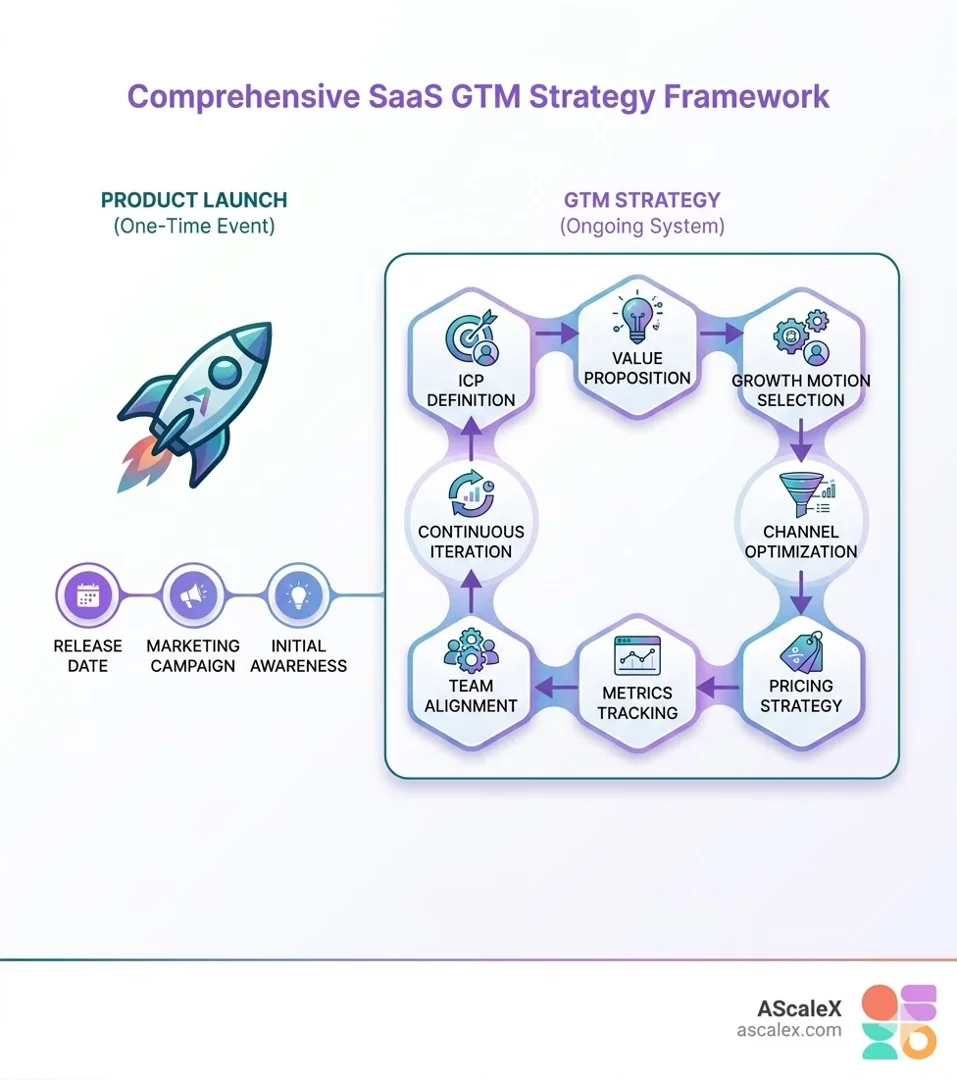
Unlike a product launch plan, which focuses solely on the initial release, a GTM strategy is a living system that evolves with your business.
Research shows 95% of new product launches fail, most often due to poor preparation. In the booming SaaS market (expected to exceed $300 billion globally by 2025), a structured GTM approach is essential.
Yet most founders treat GTM as an afterthought, confusing it with a launch campaign or relying on a single channel. The result? Misaligned teams, rising customer acquisition costs, and stalled growth.
I’m Angelique Strauss, founder of AScaleX, where I’ve spent over a decade helping tech companies scale through strategic operations and revenue-focused SaaS GTM strategy execution.
In this guide, you’ll learn how to build a high-performing SaaS GTM strategy from the ground up, even with limited resources.
The Core Pillars of a High-Performing SaaS GTM Strategy
Successful SaaS launches aren’t random. They’re built on repeatable principles. Research shows that startups with clear GTM pillars outperform peers across acquisition, retention, and growth metrics. These pillars form the framework that turns insights into action and ideas into scalable results.
Define Your Ideal Customer Profile (ICP)
The foundation of any strong GTM strategy is understanding who benefits most from your product. Many startups make the mistake of trying to appeal to everyone, which dilutes messaging and wastes resources.
A well-defined ICP should include:
- Industry and company size
- Job roles and decision-makers
- Key pain points
- Budget and purchasing authority
The more specific your ICP, the easier it is to craft targeted messaging and select the channels that will reach them effectively.
Craft a Compelling Value Proposition
Your value proposition should clearly answer: Why should someone choose your product over alternatives?
Effective value propositions focus on outcomes rather than features. Instead of listing capabilities, emphasize measurable impact—time saved, revenue increased, costs reduced, or efficiency improved. A clear value proposition also positions your product as a solution to real problems, making your messaging irresistible to your ICP.
Choose the Right Growth Motion
Not every SaaS product grows the same way. Some thrive with product-led growth (PLG), others rely on outbound sales, paid advertising, or partnerships and integrations.
The key is testing multiple channels, measuring their effectiveness, and doubling down on what works. Focus on optimizing CAC-to-LTV ratios to ensure your growth is both sustainable and profitable.
Align Sales and Marketing
A common barrier to scaling is misalignment between marketing and sales. Marketing may generate leads that sales considers unqualified, while sales teams may struggle with messaging that doesn’t resonate with prospects.
A strong GTM strategy ensures alignment through:
- Shared definitions of qualified leads
- Consistent messaging across all touchpoints
- Clear handoff processes between teams
When marketing and sales move as one, conversions increase and revenue grows faster.
Optimize Pricing and Distribution
Pricing is more than a number. It communicates value. An effective SaaS pricing strategy considers:
- Tiered plans for different customer segments
- Usage-based pricing to capture scale
- Freemium or trial entry points to reduce friction
- Enterprise contracts for high-value accounts
Couple pricing with efficient distribution channels to ensure your product reaches the right customers at the right time.
Focus on Retention and Expansion
Acquiring customers is just the beginning. Retention and expansion are what turn early success into long-term growth.
Retention strategies include:
- Strong onboarding experiences
- Continuous product education
- Proactive customer success support
- Upselling and cross-selling opportunities
Happy customers often become your most powerful marketing engine, driving referrals, case studies, and brand loyalty.
Measure, Iterate, and Scale
Your GTM strategy is only as effective as your ability to track and adjust. Focus on key metrics such as:
- Customer Acquisition Cost (CAC)
- Monthly Recurring Revenue (MRR)
- Lifetime Value (LTV)
- Churn Rate
- Conversion Rates at every stage of the funnel
Use these insights to iterate quickly. The companies that scale fastest treat GTM as an evolving system, not a static plan.
Turn Your Strategy Into Scalable Growth
Crafting a SaaS GTM strategy is a journey from uncertainty to predictable, scalable growth. It demands a deep understanding of your customers, a deliberate choice of growth motion, and a relentless focus on data-driven iteration.
At AScaleX, we help tech companies bridge the gap between a great product and a dominant market position. From rapid execution to high-impact creative, we fuel your GTM engine with the brand, video, and digital assets needed to stand out in a crowded market efficiently.
Scale your SaaS growth with AScaleX and let’s build your hero story together.